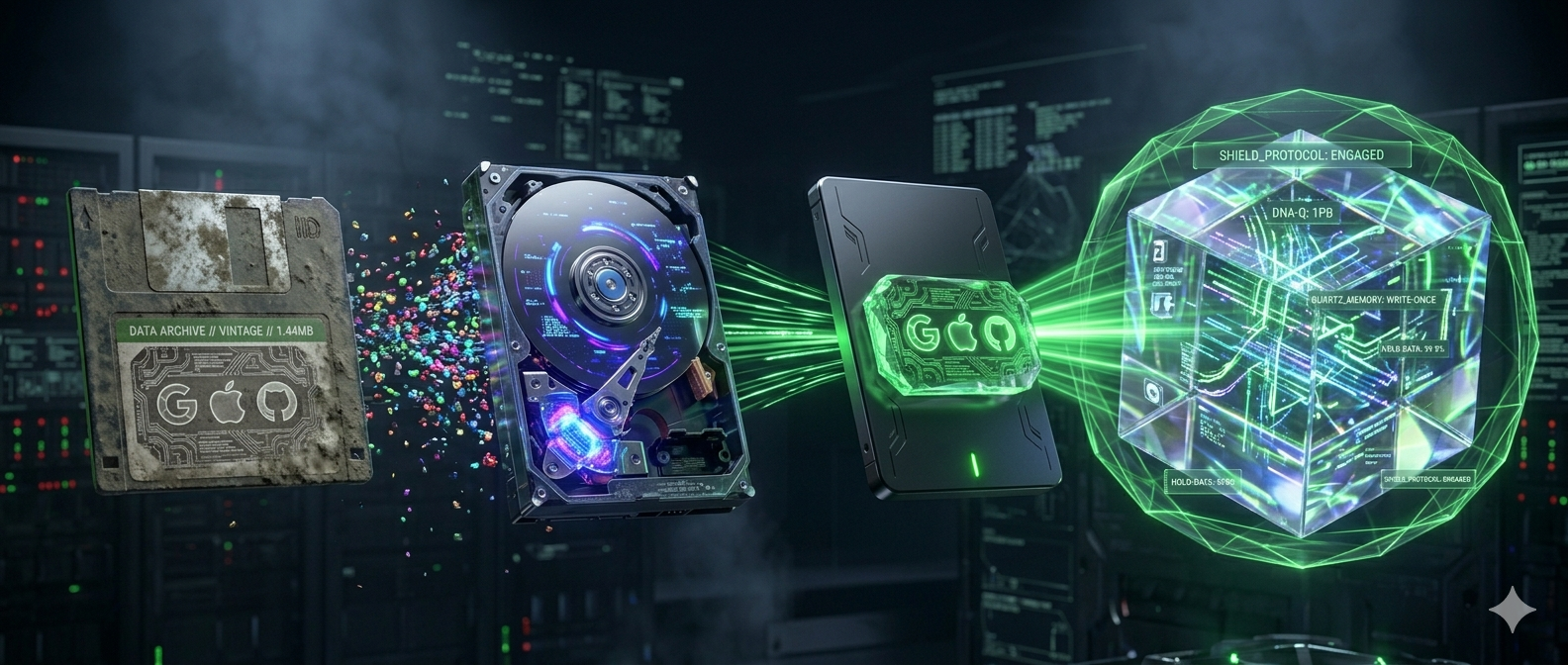
In 1996, a 1.44MB floppy disk was enough to save your world. Today, we generate petabytes of data every second. Let's look back at how our 'digital pockets' have grown and where they are heading over the last few decades.
1. The Magnetic Era: FDD & HDD
It all started with magnetism. The Floppy Disk (FDD) was commercially introduced by IBM in 1971. By the mid-90s, the 3.5-inch High-Density format became the absolute king of data transfer. However, its fragility was legendary: one magnet, a scratch, or a drop of water, and your data was gone forever.
- HDD (Hard Disk Drive): Invented by IBM in 1956 (with the RAMAC 305 system), HDDs became the workhorse of personal computing in the late 80s and 90s. Inside, mechanical platters spin at speeds up to 7200 RPM (or 15,000 RPM in enterprise solutions) while a magnetic head reads data. Despite massive leaps in capacity, their moving parts mean they have a high failure rate under physical shock or wear.
2. The Optical Revolution: CD, DVD, Blu-Ray
Lasers changed the rulebook. In 1982, Sony and Philips joined forces to release the Compact Disc (CD), shifting the industry from magnetic pulses to microscopic pits etched on a reflective surface. This was followed by the DVD in 1995 (developed by a consortium including Toshiba, Sony, and Philips), and later the Blu-Ray disc in 2006, spearheaded by Sony to push high-definition video standards up to 100GB.
Though durable against magnets, optical media introduced a new flaw: 'optical rot'—the chemical degradation of the reflective dye layer over 10-20 years, proving that plastic discs weren't meant for eternity.
3. The Silicon Age: Flash & SSD
The invention of flash memory by Dr. Fujio Masuoka at Toshiba in 1980 laid the foundation for a silent revolution. By the late 2000s, Solid-State Drives (SSD) began displacing HDDs. SSDs utilize NAND flash cells, completely removing moving parts. While they deliver breathtaking read/write speeds, they suffer from a write limit measured in TBW (Terabytes Written). Once the oxide layers degrade, the flash cells lose their ability to hold an electric charge, rendering the drive read-only or completely dead.
4. The Industry Secret: Magnetic Tape (LTO)
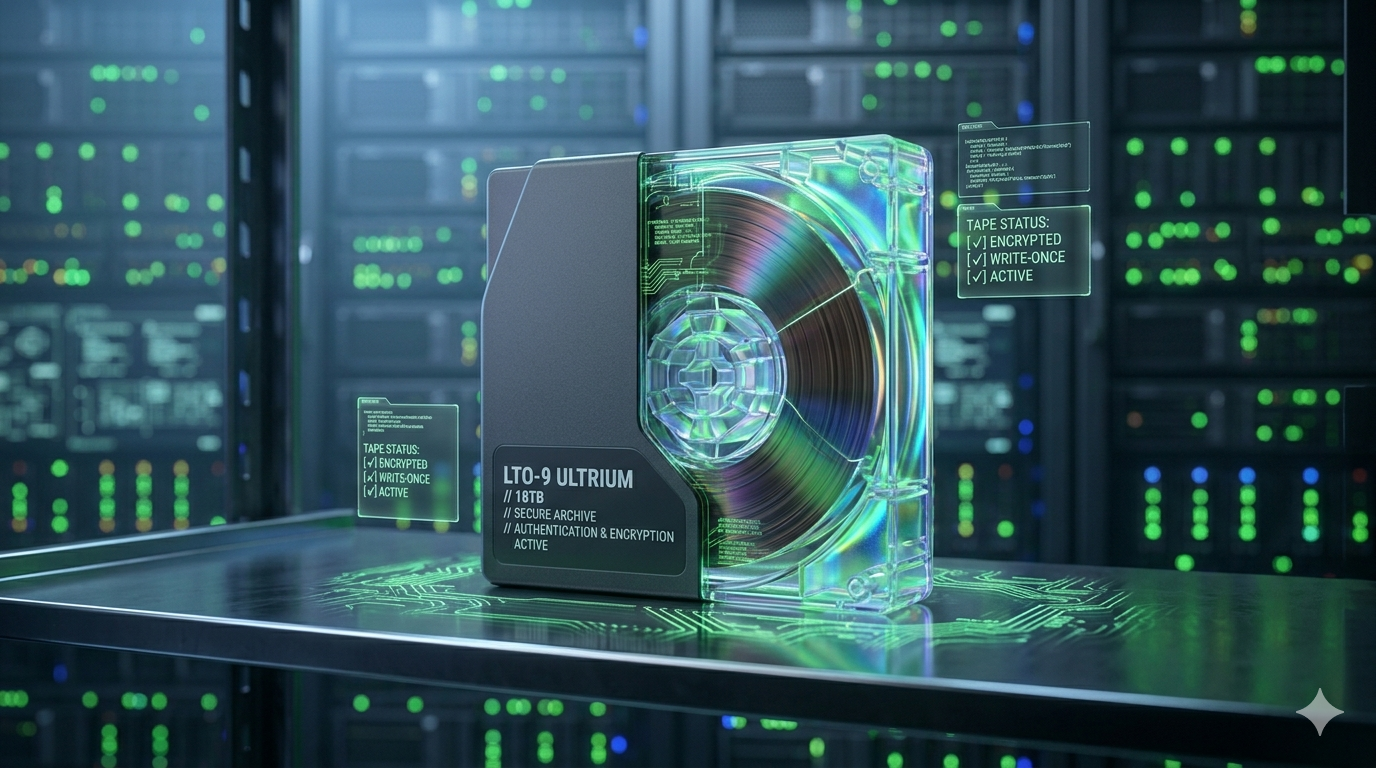
While mainstream consumers abandoned tapes in the 90s, big tech never did. In 2000, HP, IBM, and Seagate (Quantum) established the Linear Tape-Open (LTO) consortium. Magnetic tape remains the hidden backbone of modern enterprise archiving and data centers. LTO-9 tapes can hold up to 18TB of raw data and last up to 30 years in climate-controlled vaults. It is the core technology powering the deep, offline 'Cold Storage' layers of modern cloud giants due to its unbeatable cost-per-gigabyte.
5. The Future: Project Silica (Glass Storage)
The ultimate frontier of preservation bypasses plastics, silicon, and magnetic film. Pioneered by Microsoft Research, Project Silica uses ultra-fast femtosecond lasers to encode data inside quartz glass blocks. By creating permanent 3D microscopic voxels inside the stone, this media becomes resilient against electromagnetic pulses, boiling water, and intense heat, boasting an estimated lifespan of over 10,000 years without data degradation.
| Medium | Lifespan | Max Capacity | Write Speed | Read Speed | Main Risk |
|---|---|---|---|---|---|
| FDD (3.5") | 3-5 Years | 1.44 MB | ~30 KB/s | ~60 KB/s | Demagnetization / Dust |
| HDD (SATA/SAS) | 3-5 Years | 24 - 30 TB | 150-250 MB/s | 200-270 MB/s | Mechanical wear / Shocks |
| SSD (NVMe PCIe 4/5) | 5-10 Years | 4 - 8 TB | 1,500-10,000 MB/s | 2,000-14,000 MB/s | TBW limit / Gate leakage |
| LTO-9 Tape | 30 Years | 18 TB (45TB Comp.) | up to 400 MB/s | up to 400 MB/s | Humidity / Tape tension |
| Quartz Glass (Silica) | 10,000+ Years | ~7 TB (per plate) | ~10-50 MB/s (laser) | Fast (optical scan) | Physical shattering |
Conclusion
From the magnetic hum of a floppy drive to the silent permanence of etched glass, our journey has always been about one thing: making sure our digital legacy doesn't vanish. No matter the medium, the mission remains the same.